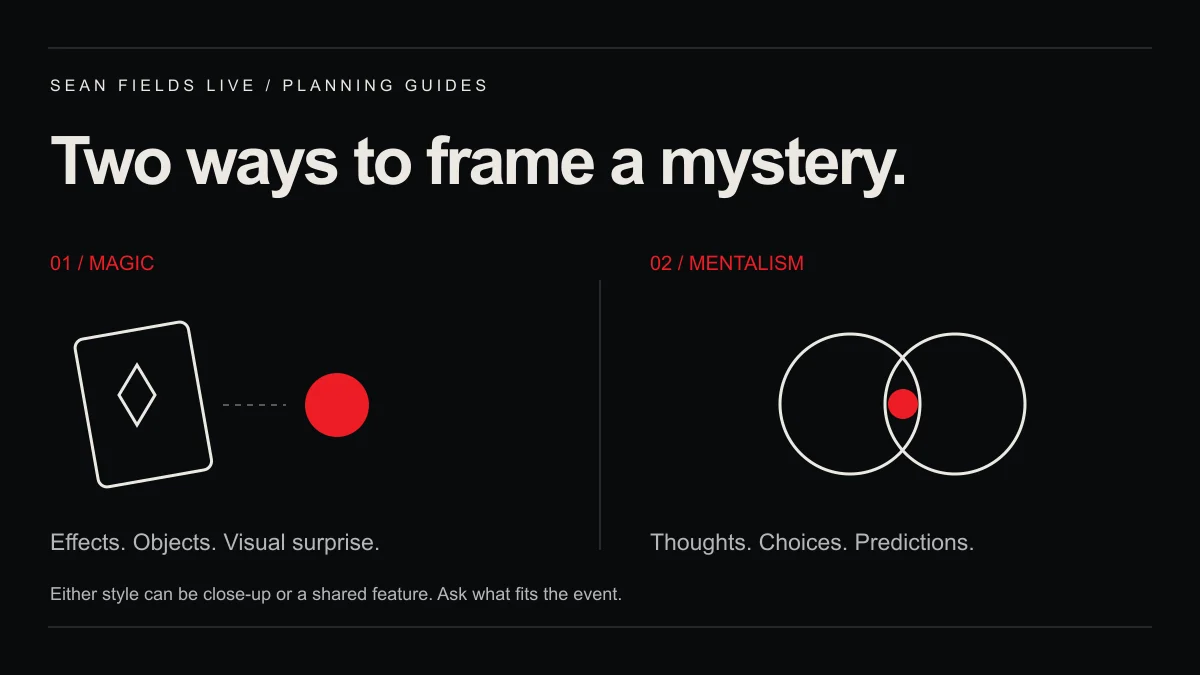
A magician generally frames the experience around impossible effects; a mentalist focuses on apparent mind reading, predictions and choices. The styles can overlap, and either can be performed close-up or for a seated audience. Choose the experience and audience fit rather than relying on the label alone.
Start with what your guests will experience
If you are choosing entertainment for a dinner, reception or private celebration, the useful question is not which title sounds more impressive. It is what the performer will ask your guests to watch, think about and participate in.
Magic often emphasizes a visible impossibility: something changes, disappears or happens in a way the audience cannot explain. Mentalism frames the mystery around thoughts, decisions, predictions or information that appears impossible to know. Those are descriptions of theatrical experiences, not claims of supernatural ability.
Sean Fields offers magic and mentalism in Winnipeg. His existing performance options combine interactive entertainment with a respectful approach to participation. Discuss the proposed experience rather than assuming that one label describes every part of the show.
How the two styles compare
This table explains common framing differences. Individual performances can combine elements of both.
| Question | Magic | Mentalism |
|---|---|---|
| What is the mystery about? | An apparently impossible event or transformation | An apparently impossible insight, prediction or connection |
| What might guests notice? | Visual effects, objects, timing and surprise | Choices, thoughts, information and unexpected outcomes |
| Is it interactive? | It can be; the performer determines the approach | It can be; confirm how participation works |
| Does it require a stage? | Not automatically | Not automatically |
| Can the styles overlap? | Yes, within a combined performance | Yes, within a combined performance |
Do not use the table as a guarantee of props, routines or audience involvement. Ask the performer how the proposed show will work for your actual event.
Style and format are two different decisions
“Mentalist” describes a style of experience. “Close-up” describes how near the audience is to the performance. “Featured show” describes a shared part of the program. Treating these as separate decisions makes the booking conversation much clearer.
A reception may call for intimate interactions among small groups, whether the moments are visual, thought-based or a mixture. A seated dinner may suit a shared feature that brings the room together. Neither setting makes one style automatically the right answer.
The close-up versus stage magic guide compares room layout, guest flow and timing. Choose those practical conditions alongside the tone of the material.
Ask about participation before you choose
A thoughtful host wants guests to feel included without feeling trapped. Ask whether people contribute from their seats, join the performer, make choices as a group or simply watch. Discuss what happens when someone would rather not participate.
The word “interactive” does not establish an embarrassment policy. Sean’s published approach invites guests into the experience without making them the punchline. If a guest of honour dislikes attention, say so in the brief rather than expecting the performer to discover it during the show.
Keep personal information out of the inquiry unless it is needed to make the event work. A clear statement such as “our guest of honour prefers to watch” is usually more useful than an unnecessary explanation of why.
Match the experience to the atmosphere
For a company audience
Describe the occasion and tone: a formal awards dinner, relaxed staff celebration or client reception. Ask how the entertainment fits that setting and how guests will know when to focus. The corporate performance options describe Sean’s featured, close-up and hybrid formats.
For an intimate private gathering
Explain the room, group size and reason for the celebration. A small group can watch a shared performance; it does not automatically need a roaming format. Decide whether you want entertainment to be the centrepiece or one part of a social evening.
For a mixed group with different expectations
Share any audience-fit questions early. Clean material, an adult audience, a quiet room and active participation are different considerations. A recommendation should account for the people and venue rather than treating “magician” or “mentalist” as a complete specification.
Five questions that move the decision forward
- What will the audience experience in the proposed performance?
- How much participation is involved, and how is it invited?
- Does this work best close-up, as a shared feature or as a hybrid?
- What room conditions and schedule does that format need?
- How does the proposed performance compare with the reel or examples we watched?
For the rest of the booking process, use the questions-to-ask checklist. Once the experience is clear, confirm timing, production responsibilities and the scope of the proposal.
A few more useful answers.
Is a mentalist claiming to read minds for real?
For event planning, treat mentalism as theatrical entertainment built around apparent mind reading, predictions and choices. Ask how the performer presents the experience rather than assuming a supernatural claim.
Can one performer combine magic and mentalism?
Yes. A performance can include elements of both. Ask about the experience proposed for your event, because the mix and format can vary.
Does mentalism always need audience volunteers on stage?
No single participation format applies to every show. Ask whether people contribute from their seats, join the performer, make group choices or watch without taking an active role.
Is one style automatically more suitable for a corporate event?
No. Audience fit, tone, timing, room conditions and professional delivery matter alongside the type of material. Describe your event and ask for a recommendation.

Sean Fields
Sean Fields is a Winnipeg-born magician, mentalist, magic creator and consultant with more than two decades of experience. His work spans close-up magic, corporate stages and creative consulting for television productions. These guides help organizers plan the setting, timing and guest experience for live entertainment.
More about Sean Fields