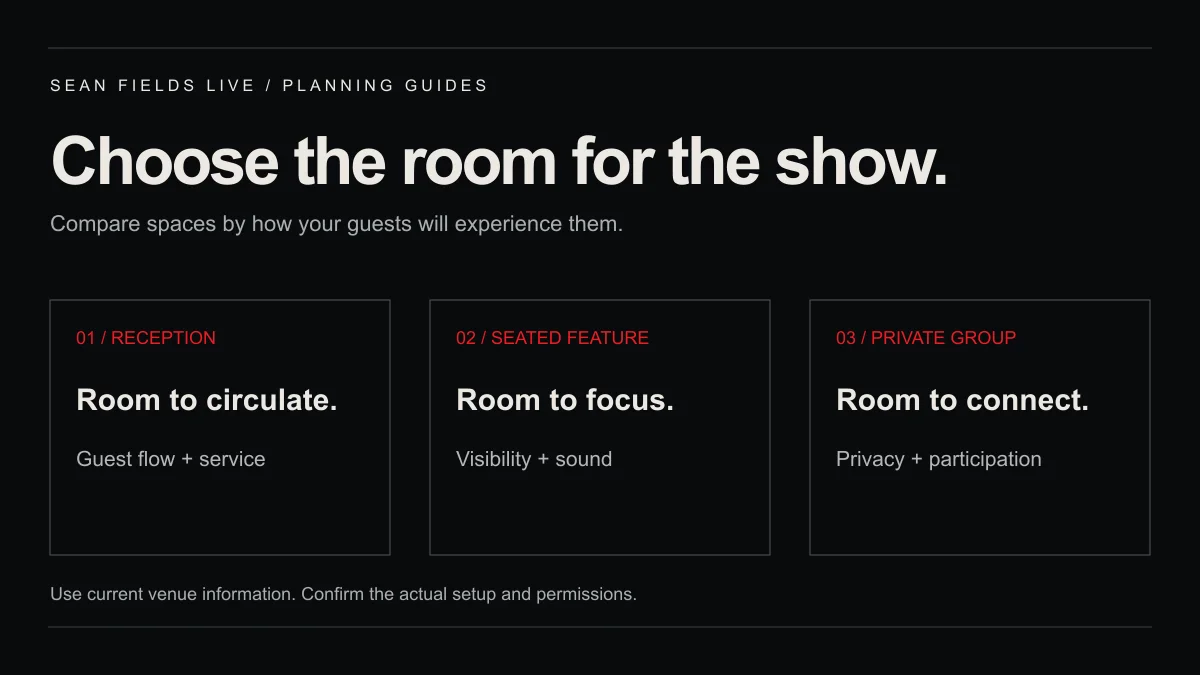
Choose the room for the experience you want: circulation and small-group access for close-up magic, or clear sightlines and a shared focus for a featured show. Use current venue information, then confirm the actual layout, service plan and permissions with the venue and performer. A venue’s name alone cannot establish suitability.
Decide what the room needs to let guests do
Before comparing décor or a venue shortlist, decide whether guests should circulate, watch together or do both at different points in the event. That gives the venue conversation a practical starting point.
Bring your shortlist to a Winnipeg magician along with the audience estimate and intended format. Sean Fields offers close-up, featured and hybrid experiences, with the setup and timing reviewed for the actual event.
The examples below are sourced planning references, not a ranking of venues or a claim that Sean has performed at them. Room availability, policies and suitability for your particular show must be confirmed directly.
Compare room types by performance fit
| Room type | Potential planning fit | Questions to settle |
|---|---|---|
| Reception or lounge space | Small-group interaction during social time | Circulation, service queues, noise and the transition out |
| Banquet or meeting room | A shared feature within a seated program | Visibility, sound, service and the introduction |
| Private dining or intimate event space | A focused experience for a smaller gathering | Privacy, seating, interruptions and venue permission |
| Indoor/outdoor combination | A flexible concept requiring a detailed backup plan | Weather alternative, sound, lighting and a controlled performance area |
The room type suggests questions rather than guaranteeing a format. The format comparison explains the audience experience behind those choices.
RBC Convention Centre Winnipeg: identify the booked space
The Centre’s official event-space page describes meeting, banquet, reception and exhibition spaces across several levels, including the York Ballroom and named second-floor rooms.
That variety makes the exact room and configuration important. Send the booked space, seating plan, performance position and any move between reception and dinner. Ask who coordinates sound, lighting and access.
A large facility may suit several parts of an event, but those parts still need handoffs. The conference-planning guide covers session-to-show coordination.
Assiniboine Park: compare the individual venue options
Assiniboine Park’s event-booking information lists several settings, including The Leaf, The Pavilion and the Qualico Family Centre. They should be evaluated as individual spaces rather than treated as one interchangeable venue.
Ask for the room layout, service arrangements and access information for the space you are considering. Discuss windows, lighting conditions, guest movement and whether any part of the concept depends on an outdoor area.
Confirm current packages and terms with the venue. A general description of receptions or celebrations does not establish that every performance setup is already approved.
The Forks: separate an outing from a booked event space
The official Forks booking page identifies spaces available through its events process, including an event space on the second floor of The Forks Market and outdoor options.
If you are considering a performance there, confirm the specific space, booking procedure and applicable conditions. A casual group visit does not give the same permission as an approved event booking.
Explain whether the audience will be a private group or part of a larger public setting. Noise, guest movement, weather and control of the performance area need review with the venue and performer.
Questions to take to a venue visit
- Where would the performance happen, and can all intended guests see it?
- Can close-up groups gather without blocking service or access?
- What else will be audible during the agreed slot?
- When can the performer enter, set up and check the room?
- Who supplies and operates the agreed sound or lighting?
- What permission is required for outside entertainers, recording or room changes?
- What happens if an outdoor concept needs to move indoors?
Use the venue requirements checklist to turn answers into a production brief. Let qualified venue staff and the performer confirm equipment and safe operation.
Choose a workable plan, then confirm the room
Compare shortlisted spaces using the same event brief: audience, format, schedule, production responsibilities and total arrangements. Keep estimates and unconfirmed permissions visible until they are resolved.
If close-up interaction is the priority, the reception guide helps evaluate guest flow. If you want a shared feature, the scheduling guide helps place it alongside service and speeches.
Once the room and recommendation align, confirm the actual booking terms. A space that supports your guests and program is a stronger choice than one selected only for its appearance.
A few more useful answers.
Does a venue with a stage automatically suit the show?
The performance position is only one factor. Confirm audience sightlines, sound, lighting, room access and the actual show requirements with the venue and performer.
Should we contact a performer before choosing the venue?
You can share a shortlist and an estimated audience and schedule. Ask what conditions the proposed format needs before finalizing assumptions about the room.
Do the venue examples mean Sean has performed there?
No. They are official-source planning references and do not imply a prior performance, endorsement or partnership.
Can a venue change affect the booking proposal?
Yes, it may affect layout, timing, access, production or travel. Tell the performer about the proposed change and confirm any revised requirements and scope.

Sean Fields
Sean Fields is a Winnipeg-born magician, mentalist, magic creator and consultant with more than two decades of experience. His work spans close-up magic, corporate stages and creative consulting for television productions. These guides help organizers plan the setting, timing and guest experience for live entertainment.
More about Sean Fields