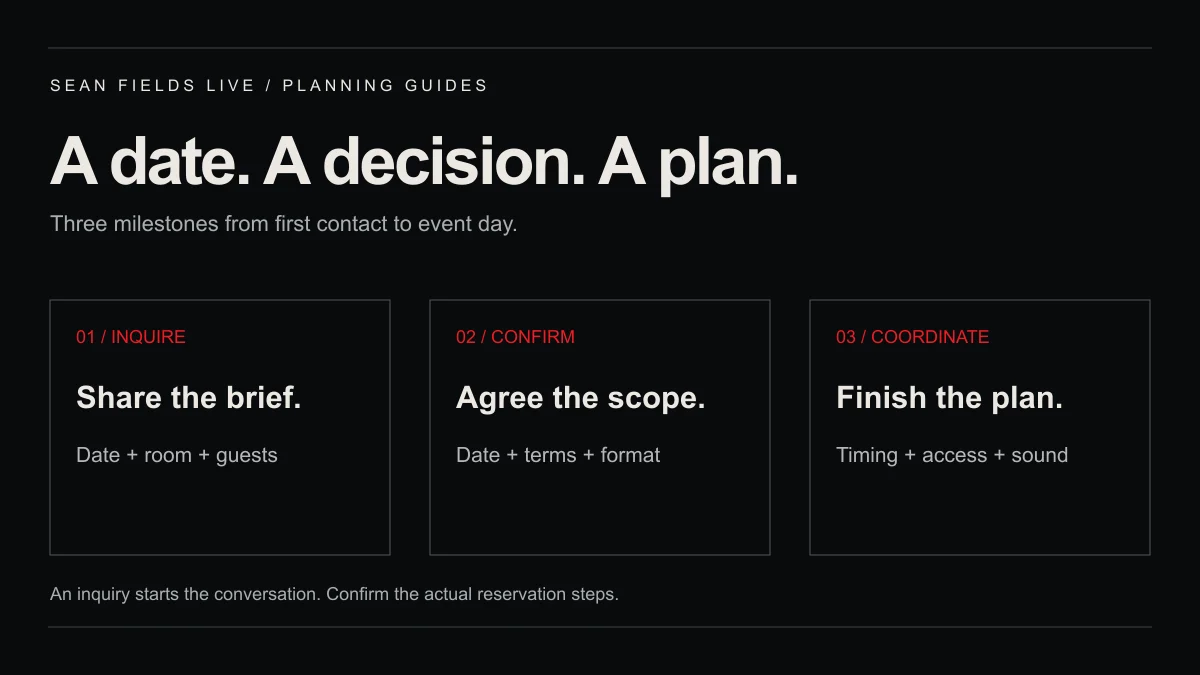
Inquire once you know the likely date, city, audience and kind of event. You can start with estimates, but an inquiry is different from a confirmed booking. Agree on the date and scope, then work through venue, schedule and production details using the milestones in your actual proposal.
Start when the event is taking shape
You do not need every production decision settled before making contact. A likely date, city, audience estimate and event purpose provide enough context to begin a useful conversation. Make clear which details are confirmed and which are provisional.
If you want to book a Winnipeg magician, explain whether the entertainment is the central feature or part of a larger program. That helps the recommendation develop alongside the schedule rather than being squeezed into the remaining space.
There is no universal “book this many months ahead” rule that guarantees availability. Dates, event commitments and planning requirements differ. Ask about your actual event rather than treating a general guideline as a reservation.
Separate the three booking milestones
| Milestone | What it establishes | What to ask |
|---|---|---|
| Initial inquiry | Whether the date and event may be a fit | What information is needed to recommend a format? |
| Booking confirmation | The agreed date, scope and commercial terms | What steps make the booking confirmed? |
| Production confirmation | The practical plan for the room and program | When must layout, timing and technical details be final? |
Do not assume that submitting a form, receiving a reply or discussing a tentative hold has reserved the date. Ask what confirms the booking and follow the written proposal. The table describes planning milestones, not Sean’s contract terms.
What to know before your first inquiry
- Your preferred date and whether alternative dates are possible.
- The venue and city, or the shortlist if a room is not booked.
- Approximate guest count and whether guests are seated or circulating.
- The event type and the role you want entertainment to play.
- The rough program, including meals, speeches and finish time.
If you do not know which format fits, say that. The close-up and stage comparison can help you describe the decision without having to choose it alone.
A guest estimate is useful when labelled as an estimate. A broad “sometime in December” inquiry is less specific than a preferred date plus two realistic alternatives.
If the venue is not confirmed yet
Tell the performer what you are considering and what is still flexible. The venue can affect format, guest visibility, access and sound, so avoid committing to production assumptions before the room is known.
For a Winnipeg dinner, identify the exact space once booked. For a Manitoba event outside the city, share the location early enough to review travel, accommodation if required and arrival margin. The performance may be one part of a larger travel commitment.
When the venue or guest count changes, ask whether the original recommendation and quote still apply. A material change should be agreed, not left for event day.
For holiday parties and other fixed dates
Once the event has a fixed date, the practical next step is to check that date. A guide cannot tell you whether a performer is available, and a claim that every popular date is already booked would be unreliable without checking.
If your company is planning a holiday party, send the proposed date and room along with the dinner and speech schedule. The Winnipeg company holiday-party planning guide shows how to coordinate a reception, meal and shared feature.
If you can be flexible, explain what flexibility really means: another date, another show slot or another format. The performer can assess those options; a later start or longer wait should not be assumed to solve every conflict.
If the event is soon, send a complete brief
A short lead time does not establish either availability or impossibility. Make the inquiry with enough information for a quick assessment, and ask what can realistically be confirmed.
- State the exact date, time, room and city.
- Give the audience estimate and a simple running order.
- Identify the venue contact and known sound or staging arrangements.
- Explain any real flexibility in timing or format.
- Ask which decisions and confirmation steps are time-sensitive.
Keep promises proportionate to what is agreed. An incomplete brief followed by assumptions about equipment, travel or timing can create more difficulty than the short notice itself.
After the booking, finish the production plan
Confirm venue access, room layout, technical responsibilities, introductions and the performance slot by the agreed milestones. Identify the event-day decision-maker and discuss how changes to the running order will be handled.
Use the booking checklist to check for unresolved questions. If your scope changes, the quote-scope guide explains why the format, coverage and travel plan need to be reviewed together.
The aim is a confirmed booking followed by a workable event plan. You can start the conversation before every detail is settled, provided you keep the uncertainties visible.
A few more useful answers.
Does sending the inquiry form reserve the date?
Do not assume that it does. Ask what steps confirm the booking and follow the written proposal or agreement. An inquiry starts the conversation.
Can we inquire before choosing between close-up and a stage show?
Yes. Share your audience, room and schedule so the performer can recommend a suitable format. Explain which details are still estimates.
What if our event date changes after booking?
Contact the performer as soon as possible and refer to the agreement. A different date needs an availability check and confirmation; it is not automatically interchangeable with the original booking.
Should we wait until every guest has replied?
You can begin with an approximate count. Identify it as an estimate and confirm when updated attendance, room layout and technical details are needed.

Sean Fields
Sean Fields is a Winnipeg-born magician, mentalist, magic creator and consultant with more than two decades of experience. His work spans close-up magic, corporate stages and creative consulting for television productions. These guides help organizers plan the setting, timing and guest experience for live entertainment.
More about Sean Fields