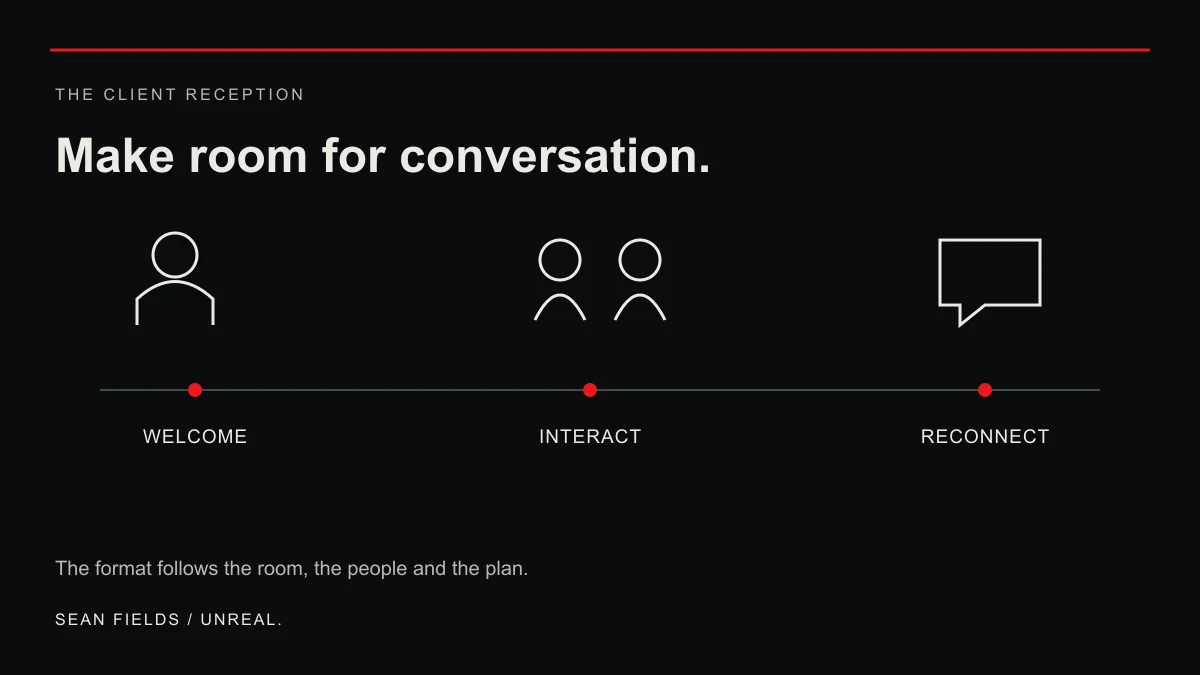
For a client appreciation event, decide whether entertainment should sit within conversation or become a scheduled shared feature. Brief the performer on arrival patterns, introductions, service and host responsibilities. Keep client meetings and any formal message separate from the performance, and assess success against the event’s actual purpose.
Set the purpose before choosing the entertainment
A client appreciation evening may bring together established contacts, new introductions and people whose relationship to your business is very different. The useful planning question is what guests should experience: relaxed hospitality, conversation across groups or a shared finish to the evening.
Discussing that purpose with a Winnipeg corporate event magician helps distinguish a circulating reception from a feature that asks everyone to stop and watch. Neither arrangement should be selected solely because the room has a spare time slot.
Make a short host brief before discussing props, duration or production. Explain who is attending, how guests know one another, whether there is a business announcement and what the hosts need time to do. Entertainment can support the setting without carrying a sales message.
Choose between conversation and a shared feature
Use this table to identify the event design you are actually asking for. Avoid promising a commercial result from an entertainment choice.
| Event need | Format to discuss | Planning constraint |
|---|---|---|
| Guests meet in small groups | Close-up interaction during a reception | Groups must be approachable without interrupting private conversations |
| A common focal point after a welcome | A scheduled shared show | Clear introduction, visible performance area and suitable sound |
| A reception and later celebration | A combined experience | Separate time blocks and an agreed transition |
The cocktail reception guide covers circulation in more detail. Here, the additional task is coordinating your hosts’ relationship-building work with the guest experience.
Brief staggered arrivals and the welcome team
A reception can have a moving audience: guests arrive, check in, find colleagues and join conversations. Tell the performer whether attendance is concentrated at the beginning or spread across the evening. State whether a formal welcome creates a natural point when most people will be present.
Assign responsibility for introductions to your host team. A performer should not have to guess who is a prospective client, a speaker or a person waiting for a private conversation. Share practical instructions without circulating unnecessary personal information about attendees.
A hypothetical plan might keep the welcome desk and entrance clear, use an open reception area for small-group interaction, then gather the room for a short address. The actual duration and coverage need to be agreed for the booked space and guest flow.
Give hospitality and entertainment compatible spaces
Winnipeg venues may offer several distinct rooms, each with its own layout and service plan. The Fort Garry Hotel’s private dining information, for example, describes settings for corporate dinners and receptions. Use the exact booked room when briefing entertainment; the hotel name does not establish the audience arrangement.
Check where staff carry trays, where guests queue and whether background music allows ordinary speech. For a shared feature, confirm the service pause and audience orientation. These venue references describe planning possibilities, not past Sean Fields bookings or venue endorsements.
The venue requirements checklist helps divide sound, access and lighting responsibilities between the organizer, venue and performer. Add your event contact to that handoff.
Set expectations for branding and participation
If you want a company reference, a product mention or an executive involved in a moment, ask before describing it in your invitation. A tailored script or branded effect should never be assumed to be included in an ordinary performance proposal.
Explain any professional sensitivities, language needs and participation preferences. Do not turn the guest list into a ranking of people to target. Invitations to take part should respect the room, and guests should not be made responsible for delivering your business message.
The audience participation guide offers questions for the briefing. Your hosts can also identify moments when the performer should leave a group to its conversation.
Finish with a practical host brief
- The purpose of the event and approximate guest count.
- Arrival pattern, welcome address and any formal business content.
- Exact venue space, audience layout and hospitality schedule.
- Preferred entertainment role and proposed time blocks.
- Host contact, introduction responsibilities and participation preferences.
- Any requested customization, with scope confirmed in advance.
Afterwards, review what you can actually observe: whether the timing worked, guests could hear, hosts had time to welcome people and the format suited the room. Do not equate a positive audience reaction with measured sales or retention. To discuss a specific evening, send the event details and ask for a recommendation around your hospitality plan.
A few more useful answers.
Can a performance include our company message?
Ask about the request before booking. Branding, scripting or custom material must be assessed and agreed separately; do not assume it is included or advertise it before confirmation.
What if guests arrive throughout the reception?
Share the arrival pattern and any formal welcome time. A circulating format may be worth discussing, but the performer needs to assess the actual room, coverage period and access to groups.
Can we keep some areas free for private conversations?
Yes, include that requirement in the brief and agree on the performance area with the venue and performer. Hosts should communicate any areas or scheduled meetings that need to remain undisturbed.
Will entertainment increase client retention?
That outcome cannot be promised from a performance. Plan for a welcoming guest experience and assess your business objectives separately using evidence appropriate to those objectives.

Sean Fields
Sean Fields is a Winnipeg-born magician, mentalist, magic creator and consultant with more than two decades of experience. His work spans close-up magic, corporate stages and creative consulting for television productions. These guides help organizers plan the setting, timing and guest experience for live entertainment.
More about Sean Fields